
Aquarium Guides · Holy Grail FC
Acrylic vs Glass Aquariums: Seams, Clarity, Weight and Cost
Picking acrylic or glass is the first big decision for a large tank. Here’s the honest, side-by-side breakdown in five minutes.
Key takeaways
- Seams: acrylic is chemically bonded into one piece; glass relies on silicone that ages.
- Clarity: acrylic is clearer than standard glass, with no green tint.
- Weight: acrylic is roughly half the weight, so delivery and setup are easier.
- Trade-off: acrylic scratches more easily, but scratches can be polished out.
- Bottom line: for 125+ gallon and custom-shaped tanks, acrylic usually wins.
At a glance
Acrylic vs Glass: Quick Comparison
| Acrylic | Glass | |
|---|---|---|
| Seams | Chemically bonded into one piece | Silicone joints |
| Clarity | Up to ~92% light, no tint | Green tint in standard glass |
| Weight | About half | Heavy |
| Impact | Won’t shatter | Can crack or shatter |
| Scratches | Scratches easier, polishable | Very scratch resistant |
| Shapes | Almost any shape | Mostly rectangles |
| Insulation | Holds heat better | Loses heat faster |
Leaks and longevity
Seams: Bonded Acrylic vs Siliconed Glass
How the panels are joined is the biggest difference between the two, and it decides how long a tank stays dry.
Glass tanks
- Silicone is the glue: it holds the panes together and seals them.
- It ages: silicone can dry out, peel or get picked at by snails.
- Common failure point: worn seams are a leading cause of glass tank leaks.
Acrylic tanks
- Solvent-welded: the cement softens both edges so they fuse together.
- One solid piece: the cured seam is acrylic, not a separate sealant.
- Built to last: that’s why long leak warranties are possible.
The HGFC difference
Every Holy Grail FC tank is chemically bonded and backed by a 15-year no-leak warranty. On a 500-gallon reef holding over 4,000 pounds of water, seam quality is everything.
The view
Clarity: Which Gives the Better View?
- Acrylic: passes up to about 92% of light with no color tint, even in thick panels.
- Standard glass: contains iron, giving a green tint that gets stronger as glass gets thicker.
- Low-iron glass: premium “ultra-clear” glass closes most of the gap, so compare fairly.
- Less distortion: acrylic bends light closer to how water does, so angled views look truer.
Delivery and durability
Weight, Strength and Shapes
Why it matters on big tanks
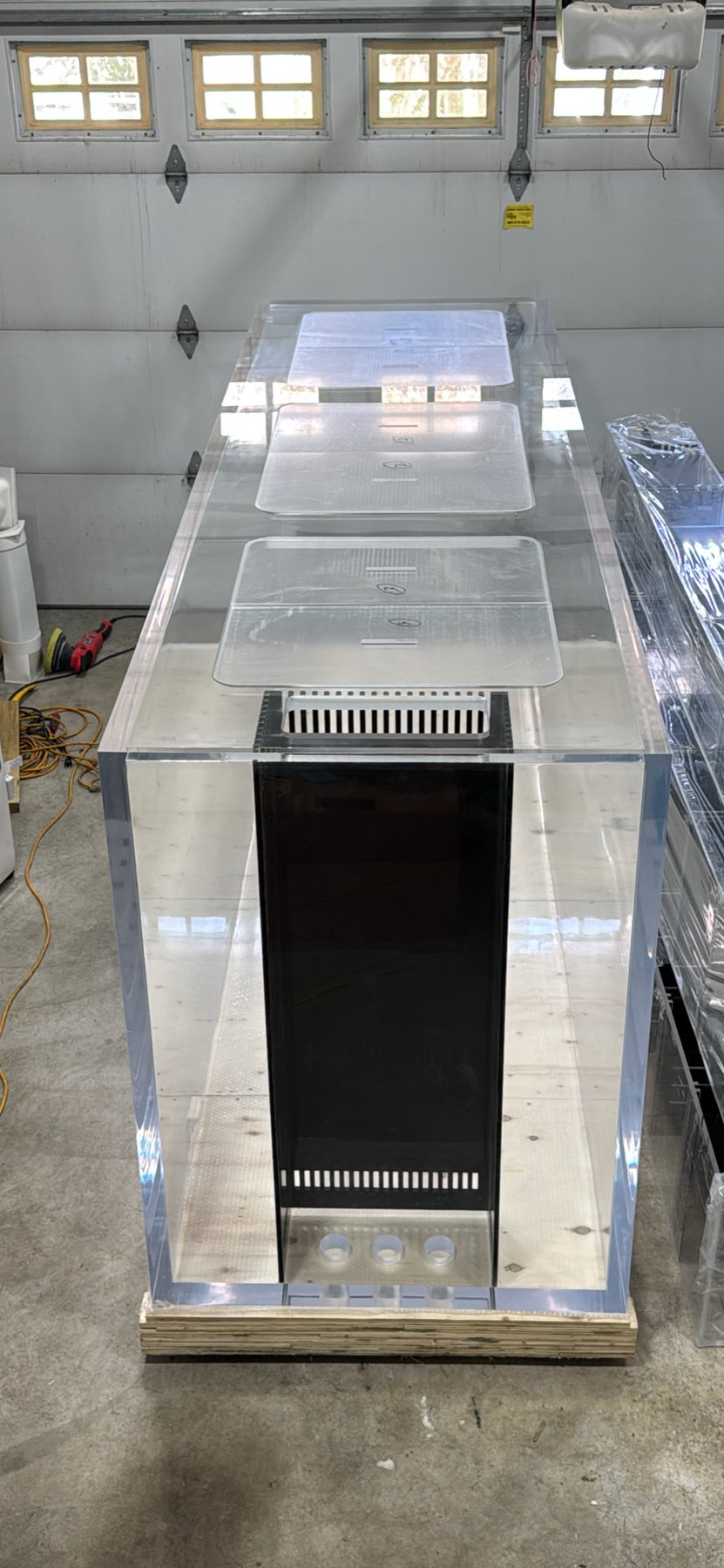
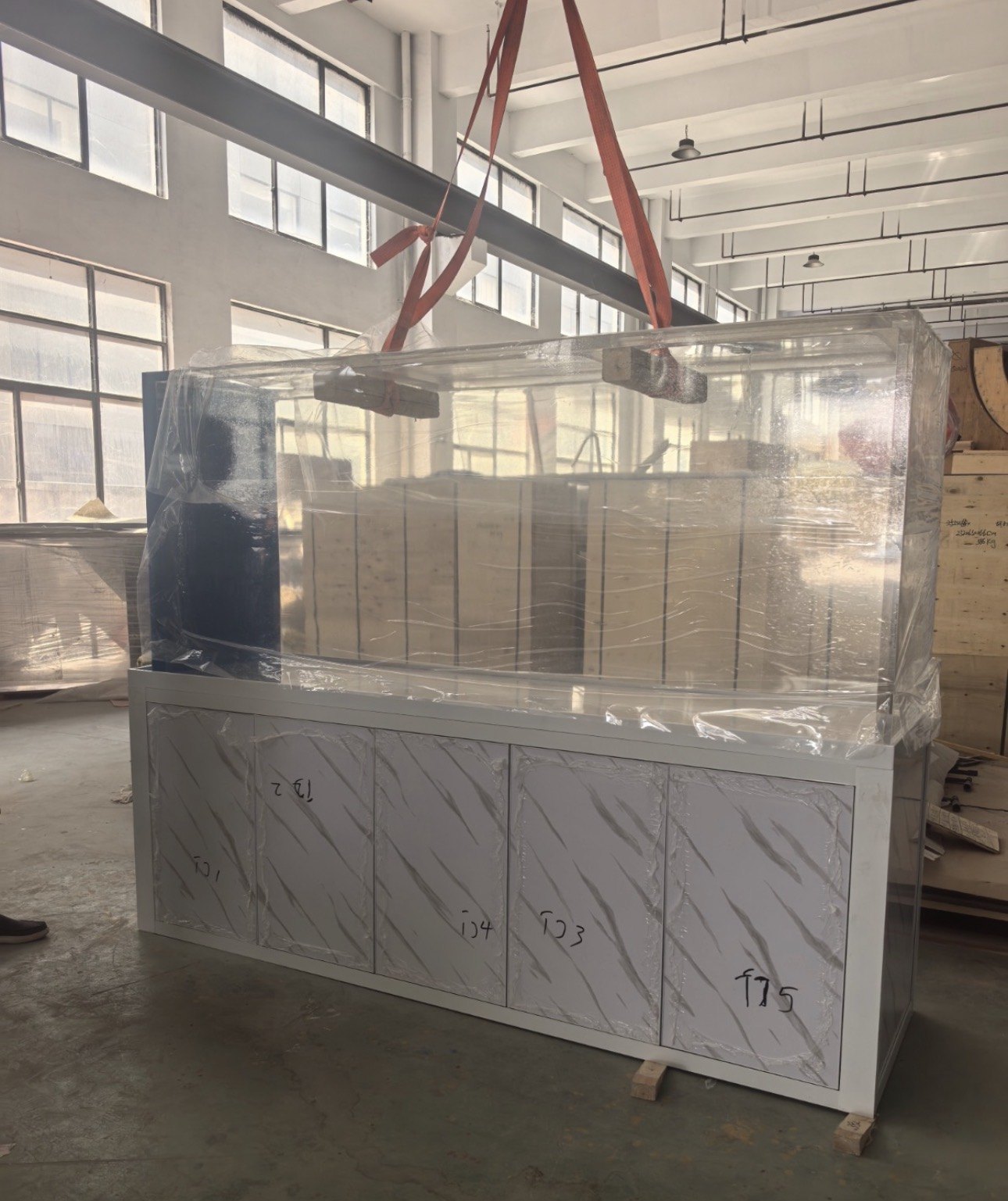
- Half the weight: hundreds of pounds less to move through doors and onto a stand.
- Tough: a bump that could crack glass usually leaves acrylic untouched.
- Safer: acrylic won’t shatter into sharp shards, great for kids, offices and lobbies.
- Any shape: bullnose, corner, racetrack, peninsula and see-through dividers.
- Drilled your way: overflows and returns placed exactly where your CAD drawing shows.
The honest trade-off
Scratches and Easy Care
Acrylic scratches more easily than glass. The upside: most acrylic scratches polish right out, while a glass scratch is usually permanent.
- Right tools: use magnets and scrapers made for acrylic.
- Mind the sand: keep your cleaning pad off the sand bed so grains don’t get trapped.
- Outside glass: wipe with microfiber and an acrylic-safe cleaner, never ammonia.
- Fix it: light scratches buff out with an acrylic scratch-removal kit.
Pro tip
Rinse your algae magnet before every use. One grain of sand is the cause of most acrylic scratches.
Budget
Cost: Acrylic vs Glass for Large Tanks
- Small tanks: mass-produced glass is usually cheaper.
- Big tanks: glass needs very thick (often low-iron) panels, which adds cost and weight.
- Custom work: special shapes, see-through designs and precise drilling favor acrylic.
- Compare the whole system: stand, sump, freight ($1,250–$2,500, quoted separately) and warranty.
- Pay over time: financing through Klarna or Afterpay at checkout.
See real prices: 72x24x24 (~180 gal) · 96x36x30 (~450 gal) · 120x30x30 (~470 gal) · all 30 standard sizes.
Making the call
Which Should You Choose?
Choose glass if…
- Small or standard: you want a small or mid-size rectangle.
- Heavy scrubbing: you clean aggressively and want max scratch resistance.
- Off the shelf: you’re buying an all-in-one system. See our Red Sea REEFER comparison.
Choose acrylic if…
- Going big: you’re planning 125 gallons or more.
- Peace of mind: you want bonded seams and a 15-year leak warranty.
- Made to fit: you need a custom shape or exact dimensions. See how our build process works.
HGFC is not affiliated with or endorsed by Red Sea.
Questions
Acrylic vs Glass FAQ
Is acrylic or glass better for a reef tank?
Both work. For large reef displays, many hobbyists prefer acrylic for its bonded seams, clarity, lighter weight and shape options. Glass is more scratch resistant and usually cheaper in small standard sizes.
Do acrylic aquariums leak less than glass?
Acrylic seams are solvent-welded so the panels fuse into one piece, while glass tanks depend on silicone that can degrade over time. HGFC backs every tank with a 15-year no-leak warranty.
Does acrylic scratch easily?
More easily than glass. Acrylic-safe tools and keeping sand out of your magnet prevent most scratches, and most can be polished out.
Is acrylic clearer than glass?
Acrylic is clearer than standard glass, which has a green tint that grows with thickness. Low-iron glass is much closer to acrylic.
What sizes does HGFC build?
New custom acrylic aquariums from 125 gallons up to 700+ gallons, shipped anywhere in the United States. See the price list or request a custom quote.
Ready for a Holy Grail Acrylic Tank?
Tell us your space and size. We’ll design your tank, stand and sump and send CAD drawings before we build. Or call 716-573-4319.
More reading: all aquarium guides

