
Aquarium Guides · Holy Grail FC
How Thick Should Acrylic Be for a Large Aquarium?
Panel thickness is the part of a big tank you never notice until it’s wrong. Here’s what decides it, in plain English, so you can ask the right questions before you buy.
Key takeaways
- Height rules: water depth drives pressure, so tank height matters more than gallons.
- Force grows fast: double the water height and the push on a panel roughly quadruples.
- Span matters too: long unbraced panels need more thickness or a strong top brace.
- Cast, not extruded: cast acrylic is the standard for serious aquariums.
- Don’t DIY the math: for 125+ gallons, thickness is an engineering decision, not a forum chart.
The physics
Why Tank Height Matters Most
- Pressure follows depth: water pushes about 0.43 psi harder for every foot of depth.
- Bottom takes the most: the lowest part of each panel feels the highest pressure.
- Gallons can mislead: a wide, shallow tank and a tall, narrow one can hold the same water with very different loads.
What that looks like on an 8 ft front panel
| Water height | Pressure at the bottom | Total push on a 96″ front panel |
|---|---|---|
| 24″ | about 0.87 psi | about 1,000 lb |
| 30″ | about 1.08 psi | about 1,560 lb |
| 36″ | about 1.30 psi | about 2,250 lb |
| 44″ | about 1.59 psi | about 3,350 lb |
Calculated for fresh water filled to the stated height. Salt water is a few percent heavier, so loads are slightly higher.
Beyond height
Other Things That Change the Right Thickness
- Unsupported span: a long front panel bends more in the middle than a short one.
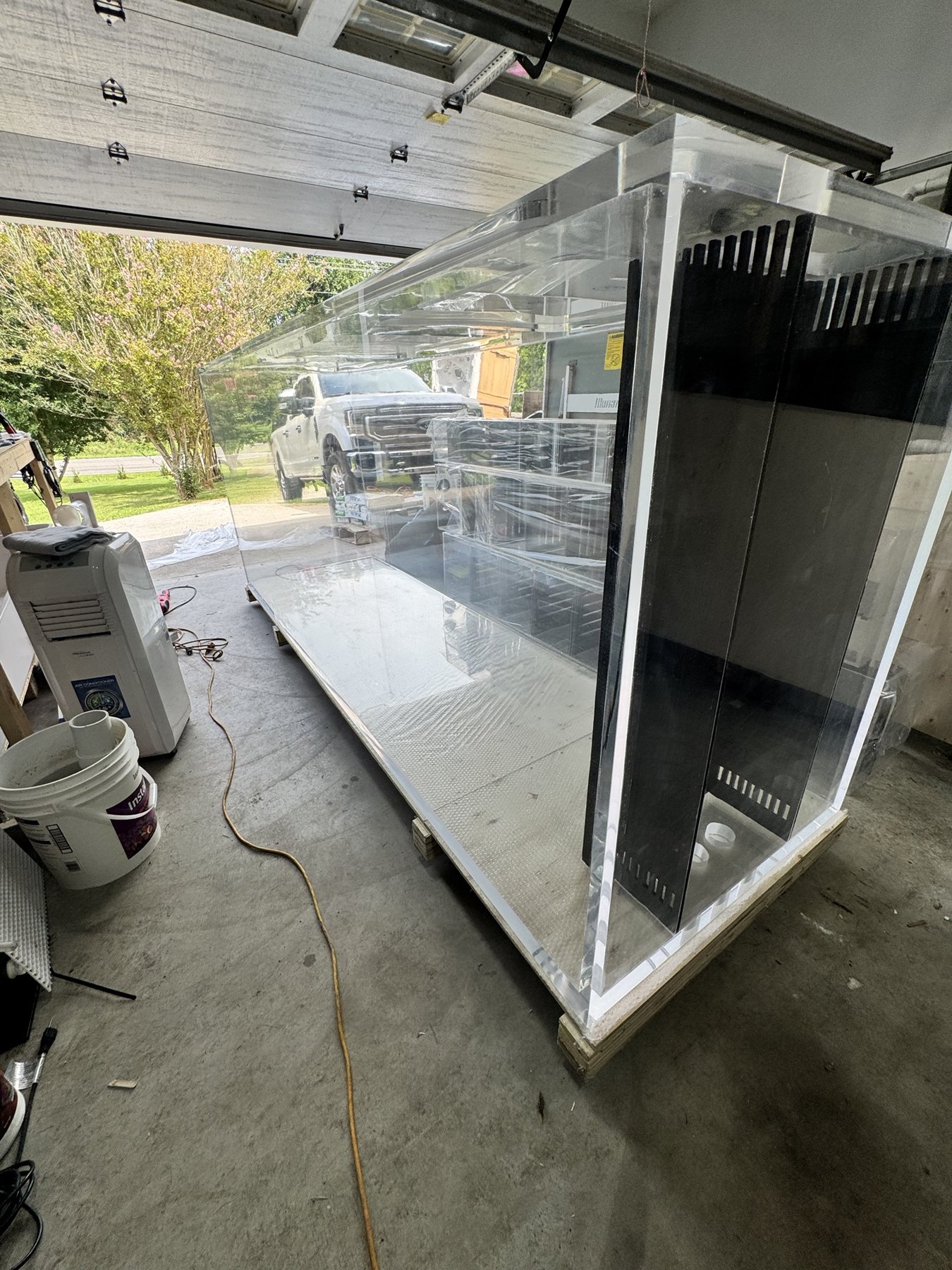
- Top bracing: most acrylic tanks have an acrylic top with access openings that braces the long panels.
- Cutouts and drilling: overflows, holes and big top openings change how loads flow, so they’re part of the design.
- Shape: curved racetrack and bullnose panels behave differently from flat ones.
- Bottom support: an acrylic bottom needs a flat, level stand top that supports it fully.
The material
Cast vs Extruded Acrylic
Thickness only helps if the sheet itself is right. Acrylic is made two ways, and they are not equal for aquariums.
Extruded acrylic
- Cheaper: pushed through a die in a continuous process.
- Softer: more prone to bowing and crazing under constant load.
- Best for: small projects, sumps and accessories.
Cast acrylic
- Stronger: better impact strength for display panels.
- Machines cleanly: crisp edges make better solvent-welded joints.
- The standard: what professional builders specify for aquariums, and what HGFC uses.
Safety margin
Why Builders Go Thicker Than the Minimum
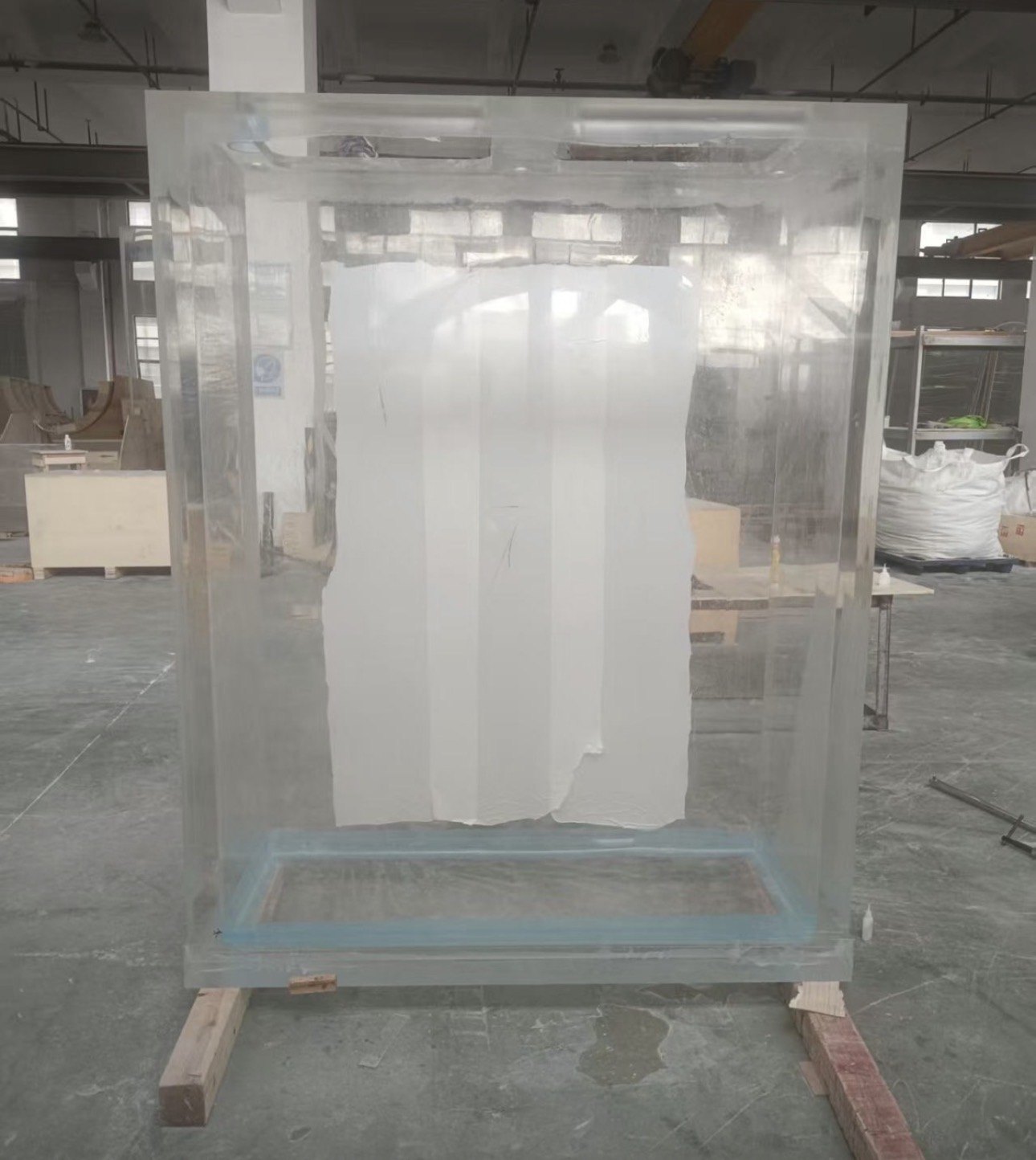
- Constant load: acrylic under years of steady pressure is weaker than in a short test, so designs carry a big margin.
- Joints matter: a well-made solvent-welded seam keeps most, not all, of the panel’s strength.
- Real life happens: scratches, temperature swings and bumps all eat into the margin.
- Less bowing: a stiffer panel keeps the view flat and true.
Pro tip
Be wary of online thickness charts. They disagree widely and rarely account for span, bracing or drilling. Ask your builder what thickness they’ll use and why.
Our approach
How HGFC Chooses Panel Thickness
- Matched to your tank: panel thickness is engineered for each tank’s height and volume.
- Reviewed with you: overflow position, drilling and other details are confirmed on CAD drawings before production.
- Want it heavier? Panel thickness is one of the options we can customize. Just ask.
- Tall tanks welcome: see sizes like the 96″ × 36″ × 36″, 72″ × 24″ × 46″ and 120″ × 24″ × 44″.
The HGFC difference
Every Holy Grail FC tank is cast acrylic with chemically bonded seams, built to order and backed by a 15-year no-leak warranty. Comparing materials? Read acrylic vs glass.
Questions
Acrylic Thickness FAQ
Is there one right thickness for a 500 gallon tank?
No. A 500-gallon tank can be long and shallow or short and tall, and those need very different panels. Height, span, bracing and drilling all factor in.
Is some bowing normal in an acrylic tank?
A properly designed tank keeps deflection small. Bowing that is easy to see, or that grows over time, is a sign the panels may be too thin and should be checked.
Is thicker acrylic less clear?
Acrylic stays very clear even in thick panels and has no green tint, unlike standard glass, which gets greener as it gets thicker.
Does a taller tank cost more?
Often, yes, because taller panels need more acrylic thickness. See real numbers in our custom aquarium cost guide.
Can you thicken or repair my existing tank?
No. HGFC builds new tanks only and doesn’t repair, reseal or refurbish existing ones. We build from 125 to 700+ gallons. See how a build works.
Planning a Tall or Extra-Large Tank?
Send us your dimensions and we’ll design it right, with CAD drawings before we build. Or call 716-573-4319.
More reading: all aquarium guides

